Wednesday, November 15, 2017

Iluminar 2017/18’, the Official Carreer Fair of the Department of Transport and Logistics Management.

Authored by Shenali Welikala


From the inception in 2007, The Society of Transport and Logistics (STL) of University of Moratuwa has been the main pillar which worked towards illuminating the minds of undergraduates on the subject area of Transport and Logistics management in the University of Moratuwa. STL is the professional body formed with the collaboration of staff and students of the Department of Transport and Logistics Management, which is the youngest department of the Faculty of Engineering of the University of Moratuwa aiming at developing a group of professionals with high level of knowledge, skills and intellectual abilities necessary to face the modern challenges in the transport and logistics industry.

“Iluminar 2017/18” is the Flagship event of STL which is the annual career fair for the final year undergraduates. From its inception in 2016 Iluminar has been able to facilitate the undergraduates who are freshly entering the corporate world.
The first ever ‘Iluminar’ took place on the 13th January 2016 at the Department of Transport and Logistics Management with the participation of 22 leading companies in Sri Lanka. Prof.Rahula Attalage graced the occasion as the Chief Guest and both the academic and non-academic staff of the Department of TLM, Industry partners ,other industry participants, alumni and undergraduates of the department of TLM participated in the event.
Taking yet another step forward Iluminar 2016/17, was held for the second consecutive year in the month of January this year with the participation of 18 companies. The event was partnered up by Brandix Lanka Limited who was the Platinum Sponsor, Hayleys Advantis Limited who was the gold sponsor, John Keels Logistics and MAS who were the silver sponsors whereas IFS and Astron were the bronze sponsors.
Iluminar 2017/18 will be held for the 3rd consecutive time on the 16th November 2017 at the Department of Transport & Logistic Management premises from 8.15 am onwards. Prof. Ananda Jayewardane, Vice Chancellor of University of Moratuwa will grace the occasion as the chief guest of the event. This time over 30 leading companies are about to attend the career fair to find their ideal employees out of a pool of young passionate minds who will be the future of the Transport and Logistics industry in Sri Lanka.
The event will be sponsored by Expo Freight (EFL) as the platinum sponsor where as John keels logistics, Hayleys Advantis and Colombo International Container Terminal Ltd will be the Gold Sponsors. 

Iluminar is in the voyage of creating a career gateway for Transport and Logistics undergraduates to choose their dream carrier paths and to get the exposure of the review process. It is the aim of STL that the undergraduates will make the best you of Iluminar2017/18 to illuminate their future careers. 

Tuesday, July 4, 2017

Teleportation instead of Transportation

Authored by Kethaka Galappaththi


The following idea won’t become a reality on next day, next year, or next century, But…. one day in the future.
Transportation, is a house-hold term that we all are aware of. But what is teleportation? It is the theoretical transfer of matter from one point to another without traversing the physical space between them. Without the technical jargons, it means sending an object from A to B simply by making it disappear at A and making it reappear at B, using quantum mechanics applications.
I’m sure you may wonder what is really meant by disappearing an object. To explain this weirdness of “disappearing” something, first you need to know about some advanced physics theories. The atom is the smallest particle that can be found in all of the elements that exist in the world, even in the air you breathe, inside you and me. And within those atoms, sub-atomic particles like electrons and protons are present as well. These elementary particles, although mentioned as particles, they behave as waves also. The name given for this concept is “wave-particle duality”.  Hence they may act as particles at one instant, but change to waves at the next instant. Therefore a specific particle may stay at one place at this moment and in the next second it may be in another place, not by moving to the next place, but by disappearing from the previous place and reappearing at the other place, due to wave-particle duality. This may startle you, if you are reading about this alien behaviour of particle for the first time. But this what really happens in the world, at least according to theoretical physicists.
If you didn’t understand my explanation on the theory behind teleportation, that’s okay. Even I don’t understand the theoretical basis behind teleportation. And you don’t need to understand it to get the essence of this article. Just keep in mind location of very small particles can be unpredictable, hence those can be anywhere at a given time.
Although this behaviour seems interesting, this cannot mould in to beneficial way for us in current state. However, if we can understand and control this particle behaviour and apply the same theory to much larger objects with the technology advancements, we will be fortunate enough to teleport almost all the matter.
In practical world only data on electron has been teleported, (source) yet. But we can be hopeful of experiencing teleportation of large objects in our life time. Then, transportation will be taken over by teleportation for the simple reason, that instead of taking a thing from A to B, teleporting from A to B may work, where this “thing” can be an object or a human also.

But, finally, I would like to tell you, not to get too excited, because all these applications are still in theoretical stage, unsure of whether those can be applied in practical world. But I will repeat that one day this concept may be used and eliminate the hindering non-value adding transportation from the world.

Monday, July 3, 2017

Voyagers or Challengers

Authored by Nadeesh Anjana

Voyager 1 and 2, ‘the most distant man-made objects’ travelling away from its home, the solar system, are still on its mission at more than 17 Billion kilometers away from the earth. Imagine the level of reliability the scientists are having on them for 40 years from their launches in 1977.
Challenger space shuttle, which is considered as one of the five space shuttles in the history of space explorations, recorded a major disaster in NASA’s missions. Challenger broke apart just after 73 seconds into its flight remaining a question about the reliability of Space shuttle missions.
‘Voyagers’ and ‘Challengers’ In Practice
Despite of the basic literal meanings, these are two kinds of humans those in existence when it is in the working world. The rest of this writing will help you reveal which type you are.  Being dependable or reliable is not only about meeting deadlines or completing tasks. It will be more accurate if you see it as giving more than 100% to your team, community or whatever the work that you are assigned for.
                                  
Even the majority of us don’t believe it is true that dependability or reliability is part of the brand value of each of us (For those who care about their brand image ! ). And it will differentiate how we are seen by others. The real problem inside this is most of us expect more from others disregarding how we are seen by others as dependable or reliable. Some people may think that the number of people who are hanging around or the passion they follow will make them more dependable. (Remember that Voyager 1 do not have an idea about Voyager 2! ). Dependable people will make others feel safe and secure in whatever the work they have put hands on. They will own or take over the work while others try to avoid the task. The powerful ‘drive’ they have to see things happened differentiate them from others.    
Take few seconds to understand which type you are, because it counts! 

Friday, May 5, 2017

'Made in China' C919 passenger jet takes maiden flight

Source: Al Jazeera and news agencies


The first large Chinese-made passenger jet has taken off on its maiden flight, a key milestone for a country seeking a place in the global aviation market.
The C919 single-aisle jet, which can hold up to 168 passengers, soured over Pudong international airport in the commercial hub Shanghai as a crowd of thousands cheered.
China is one of the biggest aviation markets, but relies on foreign-made aircraft and has long sought to enter the lucrative global jet market, which is estimated to be worth $2 trillion over the next 20 years. 
The maiden test flight had been pushed back at least twice since 2014 due to production issues. Friday's flight included a skeleton crew of five people and carried no passengers. 
Aviation analyst Tom Ballantyne told Al Jazeera that Friday's flight represented a "huge moment" for China.
"It is important for the Chinese government to show that its industrial processes are on par with the West or are heading in that direction," he said. 

C919 must 'prove itself' 

While the 39-metre long plane is made in China, foreign firms are playing key roles by supplying systems as well as engines.
The Chinese plane is touted to rival to the Airbus A320 and Boeing 737, but a spokesman for the aircraft's maker said it cannot compare. 
"You can't compare us to Boeing or Airbus, they're in a different strategic stage ... We took half a century to solve the first strategic issue [of plane development], it will also take many years to solve the second [market] problem," Jeff Cheng, a spokesman for the Commercial Aircraft Corporation of China (COMAC), told Reuters news agency prior to the maiden flight. 
Ballantyne said it will be years before the C919 will be able to fully compete with Western-made planes. 
"This Chinese aircraft will have to prove itself in operation before any Western airline will even consider purchasing it," he said.
Ballantyne added that "it is very unlikely that it will be able to compete in terms of technology and economics with the new-generation aircraft" produced by of Boeing and Airbus.

Hundreds of orders

If Friday's maiden flight is successful, COMAC, the aircraft's maker, will seek certification from China's civil aviation authority and foreign regulators.
COMAC has already received 570 orders and commitments from 23 customers, mainly Chinese-owned carriers and leasing companies. 
The safety certification of the new plane - which state media says will have a catalog price tag of around $50 million, less than half that of a Boeing 737 or Airbus A320 - could be among the biggest issues for the C919 internationally.
Questions remain regarding the safety approvals needed for the C919 to secure a foothold outside of China. 
Chinese airlines are expected drive demand over the next two decades, buying nearly 7,000 planes - mostly from Boeing and Airbus. 
China has dreamed of building its own civil aircraft since the 1970s when Jiang Qing, leader Mao Zedong's wife and a member of the notorious "Gang of Four", personally backed an attempt to do so. But the Y-10's heavy weight made it impractical and only three were ever made.
China's first domestically-made regional jet, the twin-engine regional ARJ21, flew its passengers in June 2016, eight years after its first test flight.
The development of the C919 a key step on the path laid out by Chinese leaders to transform the country into a creator of profitable technology.

Saturday, January 28, 2017

HAMBANTOTA PORT AND THE ‘KRA CANAL’ OF THAILAND.

Authored by Kamalika Peries


When you look at the map of the world  you immediately see that   ships travelling from  Indonesia to Africa or vice versa, would have found it  helpful to  visit Sri Lanka‘s fat bottom  if they needed  a port or harbor.  It was   impossible for ships to make the long east-west journey without stopping somewhere in between, during the ‘ancient period’. Today also, Sri Lanka continues to be   located at the midpoint of east and west shipping routes  and is   well placed to offer harbor facilities.
By the end of the twentieth century, it had become clear that a second harbor was badly needed in Sri Lanka. Colombo port was declining, mainly because it lacked the necessary depth and had to be continuously dredged. Bigger ships were not coming to Colombo and the ships of the future were going to be even bigger, experts observed in 2000. ‘A modern harbor down south is a better alternative’, they said, ‘there is plenty of undeveloped land there. Cost also will be lower.  The obvious location is the 6 kilometer stretch between Devinuwara (Dondra) and Hambantota.’ Interestingly, the ancient ports of Ambalantota and Godawaya are also within this segment, close to Hambantota.
It turned out that Hambantota itself was ideal for a new harbor. It was close to the sea lanes and   ships came within six to ten nautical miles (19 km) south of Hambantota every time they went from east to west.  Around 200 ships did so every day.  Hambantota had the three main attributes needed for a modern port, natural depth in the sea, a good mainland position close to shipping lanes and   thousands of acres of bare land.
A modern harbor has to have a depth of 20 meters to cater to deep draught ships and the ultra large container vessels. Hambantota had water depth of 16 to 18 meters at the entrance to the bay. This depth was available for 700 meters beyond so there would be no dredging after the port was built. Hambantota also had over 200 hectares of bay and over       5000 hectares of land that could be converted to a major industrial or port city. Hambantota, unlike Colombo, had no monsoon effects or environment problems either. Hambantota had ‘all the attractions of a major hub port’.
Hambantota port was ideally located for ship repairs, ship building, bunkering and off shore services, said the experts. Off shore services could be started straightaway using the private sector.  Several companies, operating from Galle port were already serving    the ships that went past, with spares, bunkers, ship stores and crew changes. These   companies said that Hambantota was more suitable than Galle, for expanding their services. They were even prepared to consider the construction of a quay for this purpose.
Hambantota could function as a transshipment harbor as well. 70% of the volume handled by the Colombo port at present was transshipment of goods imported by India,   Indian ports did not have adequate depth.  But Colombo port got only 10% of India’s goods, the rest went to Singapore. Hambantota could transship the lot.  A network of feeder services could also be developed connecting Hambantota not only with the Indian sub continent but also Australia, New Zealand, Philippines and Indonesia. Mega vessels are reluctant to call at the ports of these countries due to low cargo volumes, high port costs and the diversions involved.
A modern cost efficient harbor would attract these ships. This was the view of P &O Ports experts, as well, when they looked at Galle in the late 1980s. Hambantota port could also stimulate a major industrial complex in the area. Hambantota district would then emerge as another growth centre, creating employment and improving the social standards in the south.
Despite the perfect positioning and natural depth of Hambantota, the politicians looked elsewhere. Studies were made for Galle, which was absurd due to the rock patches in the sea bed in Galle, said experts. The two harbors that could be turned into international ports were Trincomalee and Hambantota. Trincomalee was not on the main sea lane and therefore a commercial harbor could be built only at Hambantota. We have ignored Hambantota because we were imitating the Dutch and the British, who for historical reasons were forced to use Colombo and Galle.  Observers noted that money spent on Colombo port was better spent on Hambantota.
On his journeys to Kirinda fisheries harbor in the 1970s Ariyaseela Wickremanayake had noticed the natural harbor at Hambantota lying vacant and unattended. Wickremanayake went to the ‘politicians’, complete with plans and maps. The ‘politicians’ he spoke to were interested in the idea of a harbor at Hambantota. By 2000 Hambantota’s potential was accepted, it only needed the finance.  ‘Who is going to give the money’?
It was President Mahinda Rajapakse who took the initiative on this matter. He obtained the support of    China, and started to build the Hambantota port in 2008, funded by China’s Exim Bank and executed by two Chinese construction firms. The first phase of the port was completed by 2010 and the harbor was formally declared open.
The port earned Rupees 750 million through fuel bunkering in 2014. Japanese, South Korean and Indian car makers used the port for transshipment of vehicles.  In the first nine months of 2014, the number of vehicles handled at Hambantota crossed the 100,000 mark. Tata and Maruti sent its vehicles. The biggest user of the port was the Hyundai plant near Chennai. All Hyundai vehicles made in South Korea, China and India would in future be transshipped through Hambantota.
The Yahapalana government criticized Rajapaksa’s Hambantota port loudly, but ended up signing a further contract with China in 2016, to complete the port. Hambantota port will eventually cover 4,000 acres of land and accommodate 33 vessels at any given time, making it the largest port in South Asia  It will be able to accommodate the new generation of mega ships, and is to include four terminals (12 berths,) bunkering and refueling facilities, liquid natural gas refineries, aviation fuel storage facilities, bonded export processing zone and dry docks.
Hambantota will serve as a key transit point for oil and gas tanks accessing the Red Sea, Persian Gulf, Malacca straits, Gwadar in Pakistan and Sitwe in Myanmar. Hambantota will also serve as a key maritime transit point to China’s expanding investments among Indian Ocean island nations.  ‘Hambantota port is your property and a good one. It is important to Sri Lanka’ said China. ‘It is now necessary to create economic activity near the port.   Sri Lanka can attract at least five billion USD from Chinese investors in the next three years to five years’.
Hambantota is starting a career as a tourist embarkation port as well. MS Rotterdam, a luxurious Netherland owned cruise ship, belonging to the American Line shipping company with 1,400 passengers and 600 crew arrived at Hambantota in February 2016 from Cochin and passengers embarked to tour Sri Lanka.
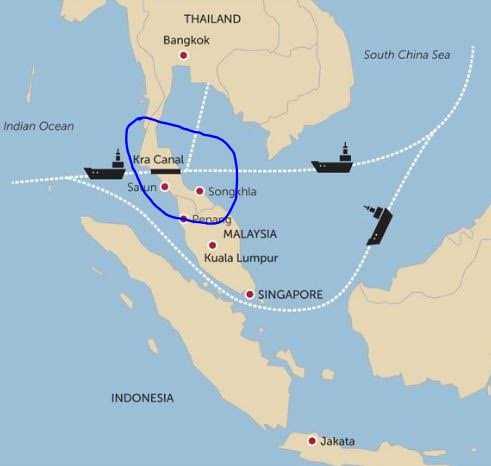
Hambantota is ideally placed to benefit from Thailand’s Kra canal when it is constructed. The king of Thailand entertained a proposal from France In 1677,   to construct a canal across the Isthmus of Kra where the Isthmus narrows to just 75 miles. This could save 1500 nautical miles for ships on the Asia -Europe sea route and trillions of dollars on fuel. But nothing happened. In 1882, Ferdinand de Lesseps, who did the Suez Canal, visited but he was not allowed to study Kra.
In 1897 Britain persuaded Thai king not to build the Kra canal so that Singapore could continue to be an important shipping hub. Singapore was the main port in the Malacca straits and   was of great importance to Britain. The Thai king needed the British to help neutralize the French power in Indochina and maintain the independence of Thailand. He could not antagonize Britain. In 1909 Britain obtained for Thailand the rights over the north Malaya states of Kelantan, Terengganu, Kedah and Perlis.  In 1946, there was a highly secretive peace treaty with Thailand in Singapore. Article 7 of this treaty says Siam undertakes to construct no canal linking the Indian Ocean and Kra canal without British consent.  One purpose was to protect Singapore.
Currently 50% of all oil imports and 80% of China’s exports pass through the Malacca straits. Shipping in this strait is extremely crowded and it is a haven for pirates and terrorists. The Kra canal would help ships avoid this ‘choke point’. It would also shorten transit time for shipments of oil to Japan and China by 1200 km, saving much time and fuel. China has therefore revived the Kra canal project as a part of the China’s Maritime Silk Belt.  China released details of the project at the 2015 Boao Forum. It was assumed that China was going to build the Kra canal straightaway, but China and Thailand denied this.
Wall Street Journal,   January 2016, predicted that sooner or later, the Thai government will agree to this project. The economic opportunity to become a regional maritime center, surpassing Singapore and Malaysia, is going to be too good to pass up. And China is patient enough to wait for Thailand’s approval, it said.   In September 2016, the media reported that China had obtained the contract to build a shipping canal across the Kra isthmus of Thailand. The canal will be 135 km long 400 meters wide and 30 meters deep and is expected to be completed within ten years. The width of the Kra Isthmus at its minimum is only 44 km but the height of the interior mountain chain is 75 m (246 ft).
The Kra canal will benefit Sri Lanka, Thailand and Malaysia. Singapore will be the main loser. USA’s Pentagon 2008 ‘Joint Operation Environment Report’ said Hambantota and Kra canal were part of China’s shipping lane strategy. Hambantota will benefit only when Kra canal starts.   Cargo from India and Bangladesh to the Far East, for instance, which presently goes through Singapore,   will be diverted to Hambantota. Kra Canal will place Hambantota direct on the Asia- Europe sea route. That will be even better than the existing route.

Tuesday, January 24, 2017

Change the way you teach… Change the way you learn…

authored by Indiwaree Chandrasekara
Inspired by: Vidura Withanapathirana and Prince Ea

Most of us, maybe we all are products of traditional teaching. The chance of us having met a teacher who teaches his or her students to imagine, build and realize no matter what the subject is very less.  When this question is asked from most of the teachers, they give various reasons for not doing so. Some of those excuses include, “no time to create mental pictures within the short time given”, “students do not expect such a thing”, “that is impossible” and so on. But, the immense value in doing so can only be seen once you try it whole heartedly.
Some time back I had the opportunity of meeting a peer, an undergraduate of the Engineering Faculty who teaches to a group of Sunday school students as well. It would not be wrong if I say this article is mostly inspired by his story. In order to introduce him, the best words I could use are an ‘explorer’ and an ‘experimenter’ who has made use of several techniques time to time in his teaching. From so called teacher based traditional teaching to mental illustrations of facts, he has tried. Out of all the methods, he has noticed a major turnaround in the latter. Yes, he punishes his students as every teacher does for their unacceptable behavior but at the end of the day the transformation he sees in that student is quite exceptional. The aim of writing this article is that at least one person who reads and gets inspired would experiment by him or herself, continue to pass this message and eventually add up to an educational evolution.
How does this change happen? How does that teacher be able to win that student? The answer for this lies solely on the method he uses to teach. It is quite easy, quite fun and quite creative. Treat each and every word you release from your mouth as another opportunity to draw a colorful picture in students’ mind. Do not give out all the details of your picture but keep some space for them to contribute as well. Do not miss even a single component but include even the smallest element. And yes, this takes time, but guaranteed it is not wasted. Because the student does not stop thinking and building the graphics inside his head with the end of the subject but even after that. He starts to live in it. He makes it his own world, own colors and own subject. He builds up the confidence; he starts to think no one else has the colorful world as he built. And after all, it is strong enough to overcome the grudge he has on his punishment. He embraces the subject, makes it his favorite and continues.
Most importantly this does not stop there. Every work he or she does, whatever the job they will need to perform in their lives, they learn to lead, be the best, innovate everyday and inspire despite of their position or the title. This is because they make it their self painted world with high standards and it is above what competition could do.
However, why do you need to care on this? Why do you have to embrace this strange technique above all? Cause the answer lies on the fact that teachers and only teachers can impact one’s future after the same person himself. Cause teachers save the tomorrow of their students. Because student expects each and every teacher they meet will learn something new, something to cling and something that will change their lives.

It is high time to stop making students walk on each other, make them rivals and force them. It is time to let them be independent but coordinative, imaginative but open, memorable not memorize able. You only have to repeat this already experimented technique, experience the change by yourself, spread the word if it works and most importantly, remember every single student sitting in front of you has his or her own colorful world, own capacities and own interests so do the learning process and speed.

Tuesday, December 6, 2016

Field visit to DOLOSBAGE

authored by M M.Mohamed Shaja and Vaishnavy Perinparaja


Every year the first year students of Transport and Logistics Management department, University of Moratuwa are given a chance to go on a field visit to a place where we can see the geographical features with the guidance of lecturer of Geography subject. This year, our lecturer has chosen a place which is called “Dolosbage”.


“Dolosbage” is a small charm and quaint village which can be easily accessed via several roads Gampola, Ruwanwella, and Awissawella being some of the preferred routes. Either side of the road is covered with greenly tea estates remembering the trip to hill country. It is situated in Sabaragamuwa province, Sri Lanka. Its geographical coordinates are 704’50” North (latitude), 80028’23” East (longitude).

We were got an e-mail from the lecturer Miss. Shashini Ranabahu who has organized this trip regarding the date and list of things to be brought on that day. Finally, the big day arrived. All of my friends and the lecturers came to the University and assembled near the old TLM building at 4.45 a.m. on 18th November 2016, equipped with our bags.


Field visits are common for us and hiking too. But until reach that place, we have no idea this filed visit going to break our travel records. We never expect this department based field trip is going to influence a lot in our personality and going to check our confidence and stamina level. All of us are well familiar with bus travel. But anyway this bus travelling is little bit different. The path is full of curves, ups and downs. Even going to Dolosbage by bus is full of thrill and excitement. But our destination; Dolosbage, broke out all other excitements and made us stunned.


This hiking is really a good challenge for us. The mountain is really looked like a cute little island. Climbing up the mountain gave us a feel of freedom. We felt free, there were no disturbance, no traffic, no signals and no vehicles. The open air gave us bracing effect for our minds. We came across several zig zag ways, slopes, and rocky places until reach the top. We got a feel of finding the edge of Everest as we reached the top of the mountain. After reaching the top, we stayed while there, took a break and again started to climb down without any hesitations as the healthy climate of that area gave us a fresh feel to finish the hiking. Climbing down seemed easier than going up as the path is full of downs and slopes. When we reached our starting point, it started to rain as it seemed like sky was giving us a clap of appreciation for our successful adventurous hiking.

Meanwhile, we felt a single tingle in our stomach alarming that we have to take our lunch. So we had a homemade tasty rice and curry, which gave us some energy. After finishing our lunch, we all finally got into the bus awaiting for the thrill zig zag way bus journey which was completely covered with sounds, songs and fun of our department guys. At last the thrilling adventurous journey came to an end at night. We all went away to our boarding place or homes with a feel of missing.


Ads Inside Post